How to Start Preparing for Government Jobs From Scratch
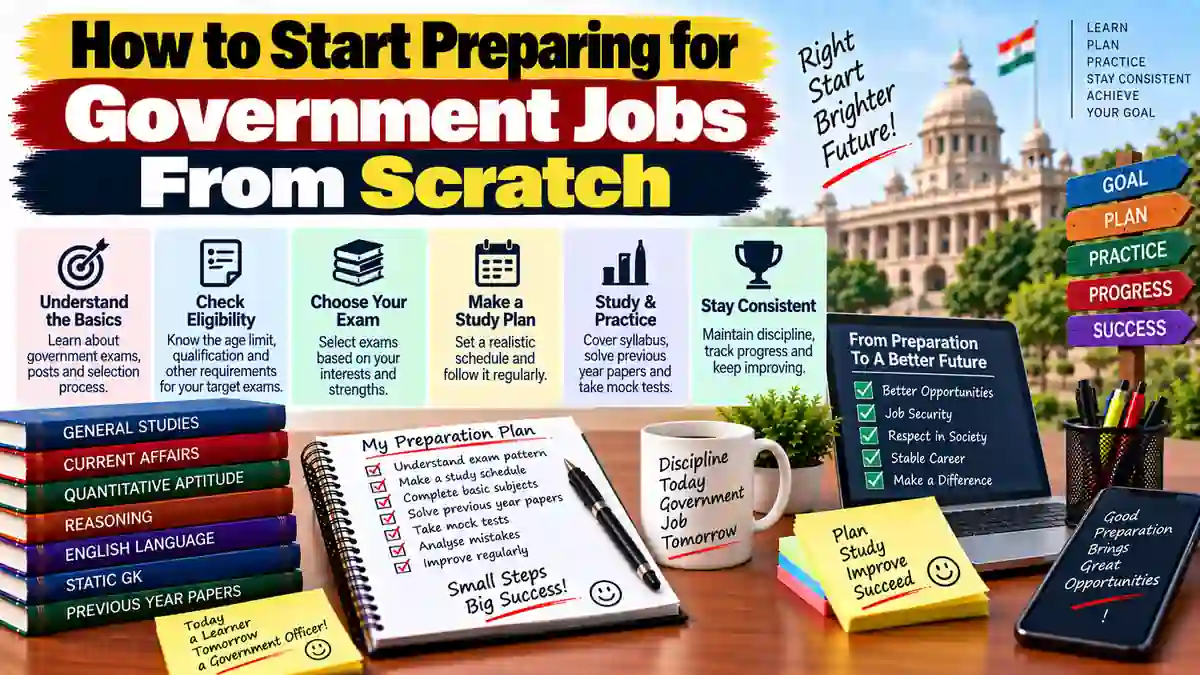
Starting government exam preparation from zero can feel confusing because there are many exams, different syllabi and several recruitment authorities. The biggest mistake is buying study material first and deciding the target later.
A better starting point is to choose a realistic group of examinations, understand exactly what they test and then build your preparation around those requirements. Candidates who are unsure which exam suits their qualification can first use this guide to find government jobs based on qualification.
Start by Choosing the Right Government Exams
Do not begin with a generic goal such as "I want a government job." Government recruitment covers very different careers, from clerical and administrative work to police, defence, railways and technical positions.
First identify your qualification and preferred type of work. You can also read how to choose the right government exam for your career before finalising your targets.
| Your Background or Preference | Areas You Can Explore |
|---|---|
| 10th pass | Selected railway, defence, police, support and other eligible recruitment |
| 12th pass | SSC CHSL, selected railway, police, defence and state-level recruitment |
| Graduate | SSC CGL, UPSC, banking, railway, State PSC and other graduate-level recruitment |
| ITI / Diploma | Technical, railway, apprenticeship and trade-specific recruitment |
| Engineering / Professional Degree | Technical and specialist recruitment along with eligible general examinations |
The table is only a starting point. Always check the current notification because qualification, age limits and other eligibility conditions differ between recruitments.
If you are specifically exploring opportunities by educational level, see the guides on government jobs after 10th, government jobs after 12th and government jobs after graduation.
Do Not Prepare for Every Exam
A beginner often creates a list of ten or fifteen examinations after seeing recruitment posts online. This usually creates more confusion than progress.
Instead, choose:
- One primary target: The examination you most want to clear.
- One or two backup targets: Exams with similar eligibility and syllabus.
- Optional specialist targets: Only when your degree, diploma or trade gives you a genuine advantage.
For example, someone preparing for a general graduate-level competitive examination may also target another exam with similar reasoning, mathematics, English and general awareness sections. That is more manageable than preparing for several completely unrelated examinations.
If you plan to combine examinations, learn how to prepare for multiple government exams at the same time without creating an unrealistic workload.
Read the Official Syllabus Before Studying
Once you have selected an examination, get the latest official notification and syllabus. Write down every subject and major topic.
Do not rely entirely on a coaching institute's topic list. Coaching material can be useful, but the official recruitment notification should be your reference for the examination structure and eligibility.
Divide the syllabus into three categories:
- Strong: Topics you already understand.
- Average: Topics you understand but need practice in.
- Weak: Topics you have never studied or regularly get wrong.
This gives you a starting point instead of randomly studying whichever topic looks easy that day. You can also use this method to identify weak subjects before a government exam.
Take a Test Before Starting Serious Preparation
If you are genuinely starting from scratch, take one previous-year paper or a reliable diagnostic mock test before studying extensively.
Do not worry about the score. The purpose is to find your starting level.
Record:
- Questions you could solve easily
- Questions you understood but could not finish in time
- Questions you guessed
- Questions you did not understand
- Topics responsible for most of your mistakes
This exercise can be surprisingly useful. You may discover that your mathematics is stronger than expected but your reasoning speed is poor, or that you know the concepts but take too long to solve questions.
Once you begin regular testing, analyzing your mock test score properly can help you decide what to improve next.
Build Your Foundation First
Beginners should not immediately start solving the hardest questions. First make sure your basic concepts are clear.
For most objective competitive examinations, this can include:
- Basic arithmetic and numerical concepts
- Fundamental reasoning patterns
- Grammar and vocabulary where English is tested
- Basic general awareness
- Reading and understanding questions quickly
The exact subjects depend on your examination. If the exam has specialized subjects, add those according to the official syllabus.
For subject-specific preparation, you can refer to guides on quantitative aptitude, reasoning and English preparation.
Use Previous-Year Papers From the Beginning
Previous-year papers should not be reserved for the final month. Use them while learning the syllabus.
They help answer practical questions such as:
- How difficult are the questions?
- Which topics appear regularly?
- How much calculation is involved?
- Which sections consume the most time?
- Are your study materials teaching you the type of questions actually asked?
After solving a paper, do not just check the answer key. Make a small error list and write down why you made each mistake.
For a more detailed approach, read how to use previous-year papers for government exam preparation.
How to Make a Daily Study Routine
You do not need a ten-hour study schedule when starting from zero. A routine that you can maintain consistently is more useful than an ambitious schedule that lasts for four days.
For example, a beginner with several hours available each day could divide study time between:
| Study Area | What to Do |
|---|---|
| Concept learning | Learn one new topic and understand the basic methods |
| Practice | Solve questions from the same topic |
| Revision | Review formulas, rules, vocabulary or notes |
| Current affairs / general awareness | Study according to the needs of your target examination |
| Test practice | Attempt timed questions or sectional tests |
If you have college or a job, reduce the daily hours rather than abandoning the plan. Consistency matters more than copying someone else's timetable.
You can build this routine using the government exam study timetable approach and adjust it around your actual responsibilities.
Give Extra Time to Weak Subjects
Many candidates repeatedly study subjects they already enjoy. It feels productive because the questions are easier, but it does not necessarily improve the overall score.
Once you know your weak areas, deliberately spend more practice time there.
For example, if you are comfortable with reasoning but struggle with arithmetic, keep reasoning in your routine but give additional time to arithmetic until your accuracy improves.
Learn the Difference Between Accuracy and Speed
A beginner often tries to solve questions as quickly as possible. This can lead to unnecessary negative marking or careless errors where applicable.
Build your preparation in stages:
- Learn the concept correctly.
- Solve questions without worrying too much about time.
- Improve accuracy.
- Gradually introduce time limits.
- Practice full sections under examination conditions.
Speed should develop from familiarity with the question types, not from rushing through every question.
For additional practice, see how to improve speed and accuracy in competitive exams.
How to Use Mock Tests Properly
Mock tests become useful when you analyze them.
After each test, divide your mistakes into categories:
| Type of Mistake | What It Means |
|---|---|
| Concept mistake | You need to study the topic again. |
| Calculation mistake | Your method may be correct but your execution needs practice. |
| Question misunderstanding | You need to slow down and read questions more carefully. |
| Time-pressure mistake | You need more timed practice or better question selection. |
| Guessing mistake | You need to improve decision-making and understand the marking scheme. |
Over time, your error list should become a revision resource. Revisiting the same mistakes is often more useful than simply taking another test.
Also read how many mock tests to attempt before a government exam so you can build testing into your preparation at the right stage.
How Much Current Affairs Should You Study?
There is no universal number of months that applies to every government examination. Current-affairs requirements vary by exam and notification.
Start by checking the previous-year papers and official syllabus to understand how much importance is given to current events. Then choose a manageable source and revise it regularly.
A common problem is collecting information from several newspapers, apps, videos and monthly PDFs without revising any of them properly. One consistent source that you actually revise can be more practical.
For a structured approach, see how to study current affairs for government exams.
Make Short Notes, Not a Second Textbook
Your notes should help you revise quickly.
For example, instead of copying an entire chapter, write down:
- Important formulas
- Rules you repeatedly forget
- Frequently confused facts
- Short methods that save time
- Mistakes from mock tests
Keep these notes short enough that you can revise them regularly.
Making short notes for competitive exam preparation can help you turn these points into a practical revision system.
Choose Study Material Carefully
You do not need five books for every subject. Too many resources can make it difficult to finish and revise anything.
A simple resource structure can be:
- One reliable concept source
- One question-practice source
- Previous-year papers
- Mock tests
- A separate current-affairs source if required
If a particular topic remains unclear, use another explanation for that topic instead of replacing your entire study material.
Do Not Ignore the Application Process
Preparation is only one part of a government recruitment cycle. Candidates sometimes study for months and then miss an application deadline.
Once you have selected your target exams, keep track of:
- Notification release
- Application start and closing dates
- Fee payment deadline
- Admit card availability
- Examination date
- Answer key or result updates
- Document verification or later selection stages
For important dates, rely on the official recruiting authority rather than an old social media post or forwarded message.
Before applying, review how to fill a government job online application form correctly and common mistakes while filling government job forms.
Keep Your Documents Ready
Having basic documents prepared can make applications less stressful.
- Educational certificates and marksheets
- Valid identity proof
- Recent photograph
- Signature in the required format
- Category certificate where applicable
- Domicile or other certificates where required
- Professional, technical or other qualification certificates where applicable
Check the notification for the exact file format, size and document requirements before uploading anything.
For a more detailed checklist, see documents required for government job online applications.
Common Beginner Mistakes
- Changing the target exam every few weeks: Give your chosen preparation plan enough time to produce results.
- Collecting too many books: More material does not automatically mean better preparation.
- Watching preparation videos all day: Learning methods is not a substitute for solving questions.
- Ignoring weak subjects: Improvement usually requires spending time where your performance is weakest.
- Starting mock tests too late: Tests can help identify weaknesses even during the early preparation stage.
- Memorizing without revision: Information that is not revised is easy to forget.
- Following an unrealistic timetable: A schedule should fit your actual daily responsibilities.
- Ignoring the job profile: Passing an examination is only useful if the resulting career suits you.
For more examples, read common government job preparation mistakes.
What If You Are Very Weak in Mathematics or English?
Do not immediately assume that you are not capable of clearing a competitive examination.
If your basics are weak, go back to the foundation level. Start with simpler questions, learn the underlying concept and increase difficulty gradually.
For mathematics, this may mean rebuilding arithmetic fundamentals before attempting advanced questions. For English, it may mean working on basic grammar, vocabulary and reading comprehension before focusing heavily on difficult questions.
The important thing is to measure progress by accuracy and understanding rather than comparing your starting point with someone who has been preparing for two years.
How Long Does Government Exam Preparation Take?
There is no fixed preparation period that guarantees success. It depends on the examination, your existing academic foundation, available study time and how consistently you practice.
A candidate who already has strong fundamentals may need less time to become exam-ready than someone rebuilding basic mathematics or language skills.
Instead of asking whether three months, six months or one year is enough, track measurable progress:
- Are your mock-test scores improving?
- Is your accuracy increasing?
- Are you solving questions faster?
- Are repeated mistakes decreasing?
- Are you completing more of the syllabus?
If you are trying to decide how much time to allocate each day, see how many hours you should study for a government exam.
A Simple First-Month Plan
If you have no idea where to begin, use the first month to build the foundation rather than trying to finish the entire syllabus.
| Week | Main Focus |
|---|---|
| Week 1 | Choose target exams, read the syllabus and take a diagnostic test |
| Week 2 | Begin basic concepts in your main subjects |
| Week 3 | Increase question practice and start topic-wise timed tests |
| Week 4 | Revise, attempt a longer mock and identify your weakest areas |
After the first month, adjust the plan based on your actual performance. Your study schedule should evolve as you learn more about your strengths and weaknesses.
You can also compare this approach with a government job exam study plan when creating your longer-term preparation strategy.
Frequently Asked Questions
Can I start government exam preparation without any coaching?
Yes. Coaching is not a mandatory requirement for most government examinations. You can use official notifications, books, previous-year papers, practice tests and other reliable learning resources to prepare independently.
Which government exam should a beginner prepare for?
There is no single beginner exam. Choose based on your qualification, age, preferred career and the type of examination you can realistically prepare for. Exams with overlapping syllabi can be easier to combine.
How many hours should I study for government exams?
There is no fixed number that works for everyone. A consistent schedule that fits your responsibilities is better than an unrealistic timetable. Focus on productive study, practice and revision rather than simply counting hours.
Should I study current affairs every day?
If current affairs are relevant to your target examination, regular study and revision can help. The amount required depends on the particular exam, so check its syllabus and previous papers before deciding how much time to allocate.
When should I start taking mock tests?
You can take a diagnostic test at the beginning and then use topic-wise and sectional tests as your preparation develops. Full-length mocks become increasingly useful once you have covered enough of the syllabus to analyze your overall performance.
Is it possible to prepare for government exams while working?
Yes. Many candidates prepare alongside employment or college. The key is to select compatible examinations and create a realistic schedule that you can maintain consistently.
Build the Habit Before Chasing the Score
If you are starting from scratch, your first goal should not be to score extremely high in a mock test. Your first goal is to build a system that you can follow every week.
Choose suitable examinations, understand their syllabus, strengthen your basics, solve previous-year questions, track your mistakes and gradually improve speed. Once these habits become consistent, your preparation becomes much easier to manage.