How to Improve English for Government Competitive Exams
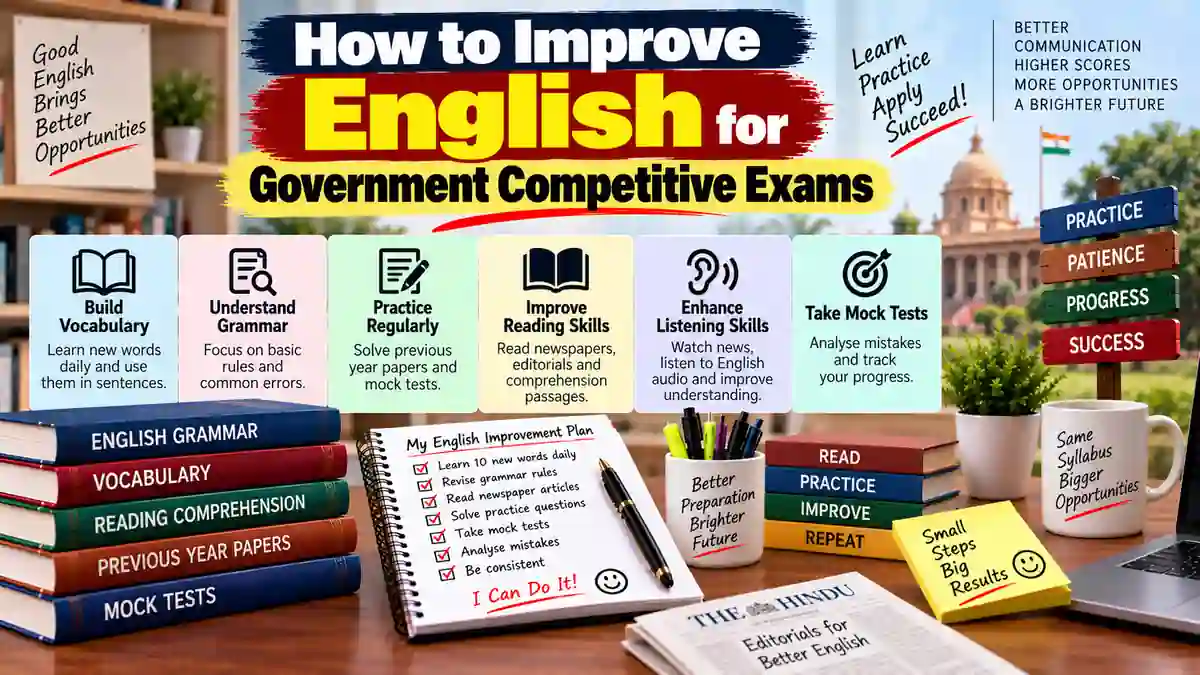
English preparation for government competitive exams becomes easier when you stop treating it as a subject that requires endless memorisation. Most candidates need a combination of grammar knowledge, vocabulary, reading ability and regular question practice.
If your English is weak, start with the basics and build gradually. If you already understand English reasonably well, spend more time on question patterns, reading speed, vocabulary revision and timed practice.
Understand the English Topics You Need to Prepare
The exact syllabus differs between examinations, but several areas appear frequently in government and competitive exams.
| Area | What to Practise |
|---|---|
| Grammar | Tenses, subject-verb agreement, articles, prepositions, conjunctions and sentence structure |
| Vocabulary | Synonyms, antonyms, meanings, usage, idioms and common word pairs |
| Reading Comprehension | Understanding passages, main ideas, details and logical inferences |
| Error Detection | Finding grammatical and usage errors in sentences |
| Fill in the Blanks | Choosing suitable words according to grammar and context |
| Cloze Test | Understanding the passage and selecting words that fit the context |
| Sentence Rearrangement | Identifying logical order and connections between sentences |
| Sentence Improvement | Identifying better grammatical or contextual alternatives |
Before creating your study plan, check the official syllabus and previous-year papers for the particular examination you are preparing for.
Strengthen Basic Grammar First
Grammar forms the foundation of many English questions. If you repeatedly make mistakes in basic grammar, jumping directly into difficult practice sets will not solve the problem.
Start with the rules that affect sentence construction most often:
- Parts of speech
- Subject-verb agreement
- Tenses
- Articles
- Prepositions
- Pronouns
- Conjunctions
- Active and passive voice
- Direct and indirect speech
- Comparisons
Do not try to memorise an entire grammar book in one sitting. Study one rule, understand a few examples and then solve questions based on that rule.
Learn Grammar Through Questions
Reading grammar rules alone can create a false sense of preparation. You should quickly move from learning a rule to applying it.
For example, after studying subject-verb agreement, solve a set of questions specifically focused on that topic. When you make a mistake, identify which rule was involved and revise it.
This creates a useful cycle:
- Learn the rule.
- Study examples.
- Solve questions.
- Analyse mistakes.
- Revise the rule.
- Solve a fresh set.
Build Vocabulary With Context
Vocabulary is easier to retain when you learn words in sentences instead of memorising long lists of isolated meanings.
When you learn a new word, note its meaning, one simple sentence and, where useful, a synonym or antonym. Pay attention to how the word is actually used.
For example, instead of memorising only the meaning of the word "reluctant", remember it through a sentence such as "He was reluctant to accept the offer." The context makes the meaning easier to recall.
Do Not Try to Learn Hundreds of Words Every Day
Large vocabulary lists can quickly become difficult to revise. A smaller number of words studied repeatedly is often more useful than learning a huge list once.
Set aside a fixed amount of time for vocabulary and revise previously learned words before adding new ones.
A simple system can be:
- Learn new words.
- Review them the next day.
- Review them again after a few days.
- Use them in sentences.
- Test yourself without looking at the meanings.
Read English Every Day
Regular reading improves vocabulary, sentence familiarity and comprehension at the same time. You do not have to start with difficult books.
Choose material that is slightly above your current comfort level. News articles, editorials, explanatory articles and quality general-interest content can all be useful.
While reading, do not stop for every unfamiliar word. First try to understand the sentence from context. Look up important words afterward and add only useful ones to your vocabulary notes.
Improve Reading Comprehension
Reading comprehension questions are not simply vocabulary tests. You need to understand what the passage actually says and distinguish it from assumptions that are not supported by the text.
When practising a passage:
- Read the passage carefully.
- Identify the central idea.
- Notice important facts and relationships.
- Read each question carefully.
- Return to the relevant part of the passage when necessary.
- Choose an answer supported by the passage.
Avoid selecting an option simply because it sounds reasonable. In comprehension questions, the passage should support your answer.
Practise Error Detection Systematically
Error detection questions become easier when you develop a fixed checking order. Instead of reading the sentence repeatedly without a plan, check common problem areas one by one.
You can check:
- Subject and verb agreement
- Tense
- Articles
- Prepositions
- Pronouns
- Modifiers
- Singular and plural forms
- Comparison
- Word usage
Keep a record of the errors you repeatedly make. If the same grammar rule appears several times in your mistake notebook, give that topic additional practice.
Understand Sentence Rearrangement
Sentence rearrangement questions are easier when you look for connections between sentences rather than guessing the order.
Look for opening sentences, pronoun references, connecting words, repeated concepts and logical progression. Words such as "however", "therefore", "this", "these" and "such" can provide clues about how sentences are connected.
Practise these questions without rushing. Once you understand the relationship between sentences, speed will improve naturally.
Practise Cloze Tests Through Context
A cloze test usually requires more than knowing the meaning of individual words. The surrounding sentence and the overall passage determine which option fits best.
Before looking closely at the options, read enough of the passage to understand its direction. Then check grammar, meaning and word usage for each blank.
When two options appear grammatically possible, use the context to determine which one makes better sense.
Use Previous-Year Questions
Previous-year questions are useful because they show the actual style and difficulty level relevant to your target examination.
After completing a topic, solve questions from previous papers related to that topic. Do not simply check the answer. Understand why the correct option is correct and why your selected option was wrong.
Maintain separate records for grammar mistakes, vocabulary mistakes and comprehension mistakes. This makes revision more focused.
Build a Daily English Routine
You can improve English with a relatively short daily session if you remain consistent.
| Activity | Suggested Time |
|---|---|
| Grammar study | 20–25 minutes |
| Vocabulary revision | 15–20 minutes |
| Reading | 15–20 minutes |
| Practice questions | 25–30 minutes |
| Mistake review | 10 minutes |
You can change these timings according to your current level. Someone with weak grammar may need more time for grammar, while a candidate who already has strong basics can spend more time on timed question practice.
Think in English During Small Daily Activities
If you regularly translate every simple sentence from your native language into English before understanding it, reading and comprehension can become slower.
Try forming simple thoughts directly in English during routine activities. Describe what you are doing, what you plan to do or what you can see around you using simple sentences.
This is not a replacement for exam preparation, but it can make basic English processing more natural over time.
Do Not Depend Only on Memorisation
Memorising grammar rules and vocabulary is necessary to some extent, but application matters more in the examination.
For example, knowing the definition of a tense does not automatically mean you will identify a tense-related error in a long sentence. Similarly, memorising the meaning of a word does not guarantee that you will select it correctly in a cloze test.
Always combine memorisation with questions and contextual reading.
Take Timed English Practice Tests
Once your basics are reasonably strong, begin solving mixed English sets within a fixed time. This helps you understand which sections are taking too long.
After each test, review both correct and incorrect answers. Sometimes a correct answer may have taken much longer than necessary, and that is also worth noticing.
Track:
- Accuracy
- Number of questions attempted
- Time taken
- Grammar topics causing errors
- Vocabulary questions missed
- Comprehension questions that took too long
Common Mistakes in English Preparation
- Memorising vocabulary without revision.
- Reading grammar rules without solving questions.
- Ignoring reading practice.
- Trying to learn too many new words at once.
- Not analysing previous-year questions.
- Guessing comprehension answers without checking the passage.
- Practising only one type of English question.
- Taking mock tests without reviewing mistakes.
A Simple 4-Week English Preparation Plan
If you are starting with weak fundamentals, a four-week cycle can help you organise your preparation.
| Week | Main Focus |
|---|---|
| Week 1 | Basic grammar, sentence structure, articles, prepositions and vocabulary building |
| Week 2 | Tenses, subject-verb agreement, error detection, fill in the blanks and vocabulary revision |
| Week 3 | Reading comprehension, cloze tests, sentence rearrangement and previous-year questions |
| Week 4 | Mixed practice, timed tests, mock tests and revision of weak areas |
After completing this cycle, continue revising grammar and vocabulary while increasing your practice with mixed sets and previous-year papers.
How to Measure Your Improvement
Your progress should be visible in more than one area. Track your accuracy, speed and the type of mistakes you make.
If you initially answer 20 questions with 12 correct answers and later reach 17 or 18 correct answers in a similar time, that is a meaningful improvement. If your accuracy is high but you take too long, focus on speed. If you are fast but make frequent errors, return to the relevant concepts.
English preparation works best when grammar, vocabulary and reading are developed together. Study a small number of concepts at a time, practise them through actual questions, read regularly and revise your mistakes. As these habits become consistent, you should find it easier to understand questions quickly and make more confident decisions during the exam.