How to Plan Your Government Job Preparation Around a Full-Time Job
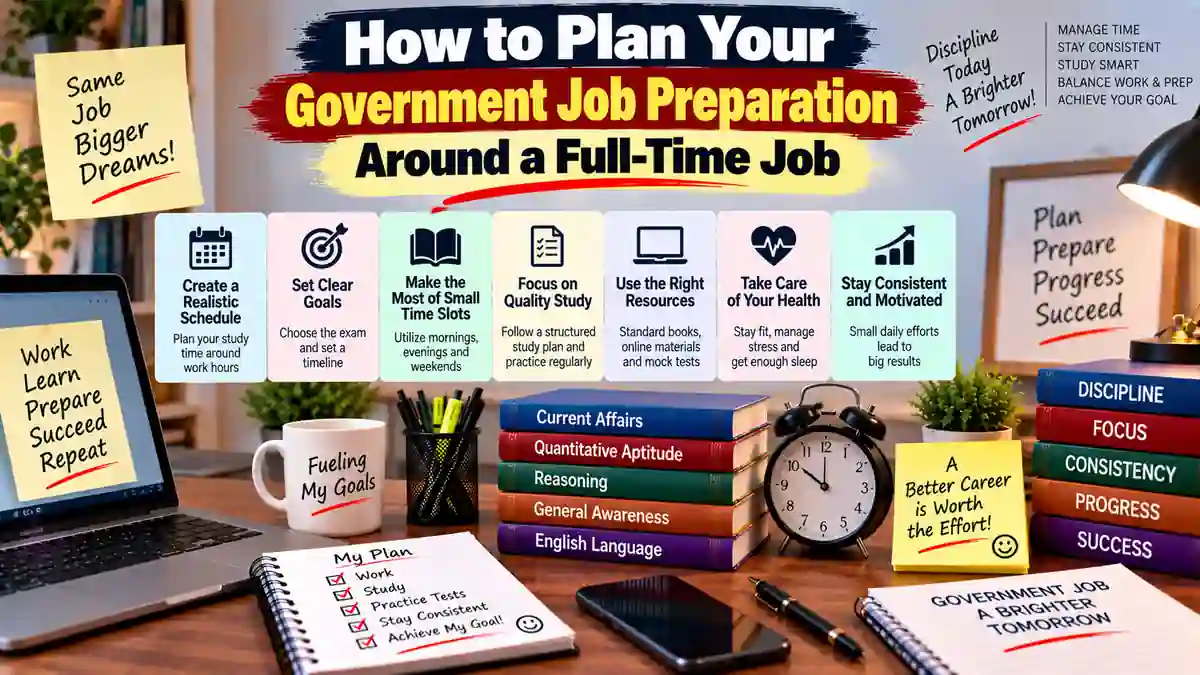
Preparing for a government job while working a full-time job can be challenging, but it is possible with a realistic study plan. The main difficulty for working candidates is usually not a lack of interest but limited time, changing work schedules, tiredness, and difficulty maintaining consistency.
Instead of trying to study for many hours every day, working candidates should focus on using their available time efficiently. A practical routine that fits around your job is generally easier to maintain than an unrealistic timetable.
Understand How Much Time You Actually Have
Before creating a study schedule, look at your normal working day. Consider your working hours, commuting time, meals, sleep, family responsibilities, and other regular commitments.
Once you know how much free time is realistically available, divide it into study sessions. Even a few focused hours each day can become useful when maintained consistently over several months.
If you are unsure how much study time you need, read how many hours you should study for a government job exam and adjust the approach according to your work schedule.
Set One Clear Examination Target
Working candidates should avoid preparing for every government examination at the same time. Different examinations can have different syllabuses, patterns, and selection processes, making preparation difficult to manage alongside a full-time job.
Start by identifying examinations for which you are eligible and select a realistic target based on your qualification, interests, and available preparation time.
Our guide on how to choose the right government exam can help you compare your options before committing to a preparation plan.
Create a Study Routine Around Your Work Schedule
Your study routine should fit your working hours rather than compete with them. Some people can concentrate better in the morning, while others prefer studying after returning from work.
A simple routine could look like this:
| Time | Activity |
|---|---|
| Before work | Study one important topic or revise previously covered material |
| Lunch or short breaks | Review short notes or current affairs when practical |
| After work | Practice questions or complete a focused study session |
| Weekend | Longer study sessions, revision, and mock tests |
The exact hours are less important than creating a routine that you can follow regularly.
Use Weekdays for Focused Study
After a full working day, it may be difficult to study every subject in depth. Instead, assign specific tasks to each weekday.
For example, one day can be used for quantitative aptitude, another for reasoning, and another for English or general awareness, depending on the examination syllabus.
You can also reserve shorter sessions for revision and question practice. This approach prevents you from spending your limited time deciding what to study each day.
A structured government exam study timetable can help you organize these sessions more effectively.
Use Weekends Strategically
Weekends can provide longer uninterrupted study periods, so they should not simply be treated as extra weekdays. Use them for activities that require more concentration or time.
- Complete difficult topics.
- Revise topics studied during the week.
- Solve previous-year questions.
- Attempt mock tests.
- Analyze mistakes.
- Prepare a plan for the upcoming week.
Previous-year papers are particularly useful because they help you understand the actual question pattern. Learn more about the importance of previous-year question papers in government exam preparation.
Make Short Study Sessions More Productive
When you have limited time, avoid spending most of the session watching lectures or reading without practicing. Divide each study session into a specific task.
For example, you could spend part of a session learning a concept and the remaining time solving questions based on it. On another day, the entire session could be dedicated to revision.
Preparing short notes for competitive exam preparation can also make revision easier when you have only a limited amount of time available.
Use Your Commute and Small Breaks Carefully
If you travel to work by public transport or have suitable breaks during the day, these periods can be used for light study activities. They may be useful for reading current affairs, reviewing notes, memorizing important facts, or revising formulas.
Do not depend on these short periods for difficult topics that require deep concentration. Keep challenging subjects for the time of day when you can study without distractions.
Do Not Sacrifice Sleep to Create More Study Hours
Working candidates may be tempted to reduce their sleep in order to study late at night or wake up extremely early. This can make the routine difficult to maintain and may reduce concentration during both work and study.
A better approach is to remove unnecessary activities from the schedule and use the recovered time for preparation. Consistency is more useful than following an exhausting routine for a few days and then stopping.
Track Your Progress Every Week
At the end of each week, check what you actually completed instead of focusing only on the number of hours studied.
- Which topics were completed?
- Which topics are still weak?
- How many questions were practiced?
- How did your mock test performance change?
- Which mistakes are repeated?
- What needs to be changed in the next week's schedule?
If your mock test scores are not improving, identify the reason instead of simply increasing study hours. Our guide on what to do if your mock test scores are not improving can help you review your approach.
Prioritize Weak Subjects
Limited study time makes prioritization especially important for working candidates. Do not spend most of your available time studying subjects that you already understand well.
Use practice tests and previous-year questions to identify your weak areas. Then allocate additional sessions to those topics while continuing regular revision of stronger subjects.
You can also learn how to identify weak subjects before a government exam and use that information to adjust your weekly plan.
Practice Time Management for the Actual Exam
Knowing the syllabus is not enough if you cannot complete the examination within the available time. Working candidates should gradually develop speed and accuracy through regular question practice and mock tests.
Do not judge your preparation only by how many questions you can solve. Pay attention to how many questions you answer correctly and how much time you spend on them.
Improving speed and accuracy in competitive exams can make your preparation more effective without requiring you to add many extra study hours.
Prepare Without Letting Your Job Take Over the Entire Routine
Your full-time job is an important responsibility, so your preparation plan should be sustainable. Avoid creating a schedule that leaves no time for rest, family responsibilities, or unexpected work commitments.
When work becomes unusually demanding, temporarily reduce the study target rather than abandoning preparation completely. You can return to the normal schedule when your workload becomes manageable.
A Practical Approach for Working Aspirants
Preparing for a government job while working full-time requires discipline, but you do not necessarily need an extremely large number of study hours. The goal should be to make every available session purposeful.
Choose a suitable examination, understand its syllabus, create a realistic weekday and weekend routine, practice questions regularly, and review your progress each week. Use previous-year papers and mock tests to measure whether your preparation is moving in the right direction.
Most importantly, build a routine that you can continue for the entire preparation period. A consistent study plan around your job is more useful than an aggressive schedule that cannot be maintained.