How Many Hours Should You Study for a Government Job Exam?
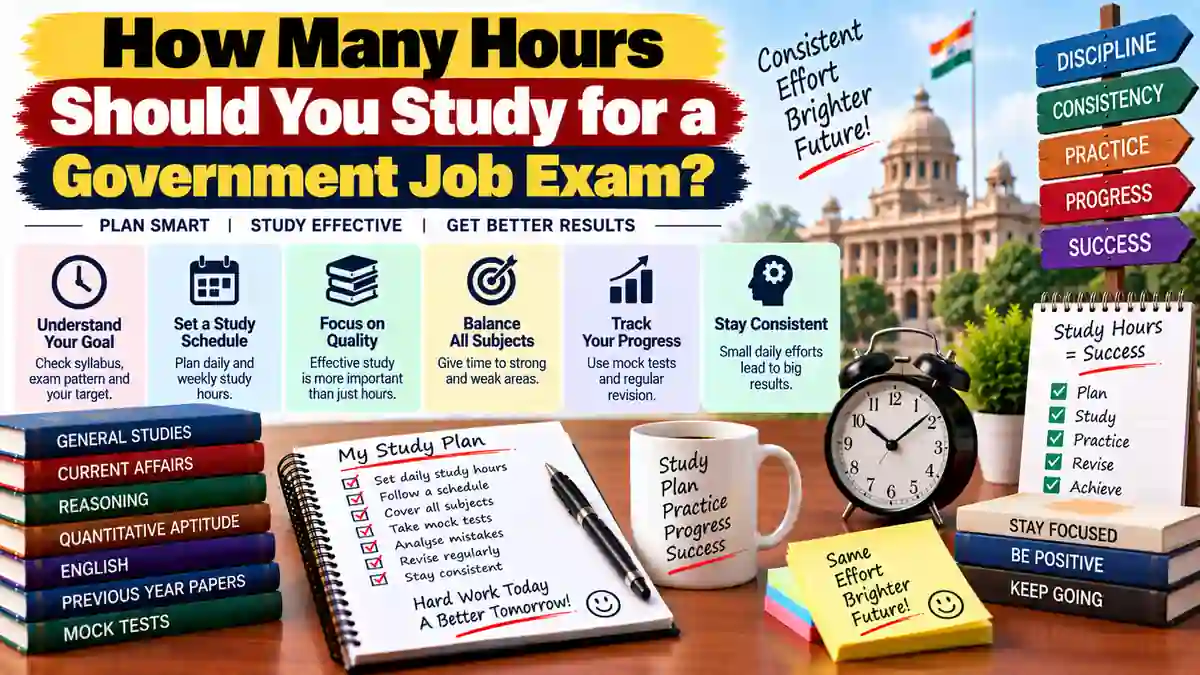
There is no fixed number of study hours that guarantees success in a government job exam. A candidate preparing full-time may be able to study for several hours each day, while someone attending college or working may have much less time available.
What matters more is whether your study time is productive, consistent and aligned with the examination syllabus. Five focused hours can be more useful than ten hours spent switching between books, videos and mobile notifications.
A Practical Daily Study Target
Your ideal study time depends mainly on your current level and daily responsibilities.
| Situation | Practical Study Range | Main Focus |
|---|---|---|
| College student | 3–5 hours | Concepts, practice and regular revision |
| Working candidate | 2–4 hours | Focused study before or after work |
| Full-time preparation | 5–8 hours | Concepts, practice, tests and revision |
| Beginner with weak basics | 3–6 hours | Foundation building before increasing test practice |
These are practical ranges, not rules. Your concentration level, examination difficulty and available time should determine the actual schedule.
Quality of Study Matters More Than the Clock
Studying for eight hours does not mean you have completed eight hours of effective preparation.
For example, a four-hour session can include:
- Learning a new concept
- Solving questions without looking at answers
- Reviewing mistakes
- Revising older topics
On the other hand, eight hours can disappear quickly if most of the time is spent watching preparation videos, searching for new books or repeatedly reading the same notes.
Track what you actually accomplish rather than simply writing "8 hours" in a study diary.
How Many Hours Should a Beginner Study?
If you are starting from scratch, jumping immediately to a very long timetable can be counterproductive.
Start with a schedule that you can maintain for several weeks. For many beginners, around three to five focused hours a day is a reasonable starting point. As concentration and study habits improve, the duration can gradually increase if necessary.
The first objective should be to understand the syllabus and build your fundamentals. There is little benefit in spending ten hours a day attempting difficult mock tests when basic concepts are still unclear.
If you are completely new to preparation, you can also follow this guide to starting government job preparation from scratch.
How Many Hours Should a Full-Time Aspirant Study?
Candidates preparing full-time may have more hours available, but that does not mean every available hour needs to be filled with study.
A focused five-to-eight-hour preparation day can include learning, question practice, revision and mock-test analysis. Breaks between sessions are useful because concentration generally drops when you continuously study for long periods.
If you can complete your daily targets in six productive hours, there is no need to force yourself to sit at the desk for another four hours just to increase the number.
How Many Hours Should Working Candidates Study?
Working candidates often have limited preparation time. The solution is to make the available time more focused rather than comparing your schedule with a full-time aspirant.
A two-to-four-hour daily routine can be divided around work.
| Time | Possible Activity |
|---|---|
| Before work | Revision, formulas, vocabulary or a focused concept session |
| After work | Question practice and topic study |
| Weekend | Longer study sessions, previous-year papers and mock tests |
Working candidates should avoid creating a schedule that leaves no time for sleep or recovery. A routine that works for months is more useful than an exhausting schedule that lasts only a week.
How to Divide Your Study Hours
Instead of spending the entire day on one subject, divide your preparation according to the requirements of your examination.
For an exam that includes quantitative aptitude, reasoning, English and general awareness, a study day could include:
| Activity | Approximate Share |
|---|---|
| Weak subject / concept building | 25–30% |
| Question practice | 25–30% |
| Second or third subject | 20–25% |
| Revision | 10–15% |
| Test analysis / current affairs where relevant | 10–15% |
These percentages are flexible. Your weak subjects should receive more attention than subjects in which you are already performing strongly. You can also use a structured government exam study timetable to organize these study blocks.
Study More During the Right Stage
The number of hours you need can change as the examination approaches.
Early Preparation
Spend more time understanding concepts and building your foundation. Do not worry excessively about mock-test scores at this stage.
Middle Stage
Increase question practice and previous-year papers. Start working on speed while maintaining accuracy.
Exam-Focused Stage
Give more time to mock tests, revision and weak areas. Avoid constantly adding new study material unless there is a genuine gap in your preparation.
Do Not Count Watching Videos as Full Study Time
Videos can be useful when you are learning a difficult concept, but passive watching should not make up most of your preparation.
After watching a lesson, solve questions without assistance. If you cannot apply what you just learned, you need more active practice.
A simple rule is: learn something, solve questions on it, then test yourself.
Use Short Study Sessions if You Lose Concentration
If sitting for three continuous hours does not work for you, divide the time into smaller sessions.
For example:
- 60 minutes: Mathematics concepts and practice
- 10–15 minutes: Break
- 60 minutes: Reasoning
- 10–15 minutes: Break
- 60 minutes: English or another subject
- 10–15 minutes: Break
- 45–60 minutes: Revision and error analysis
The exact duration is not important. The purpose is to keep your attention on one task at a time.
Include Revision in Your Daily Hours
Finishing new chapters every day can create a false sense of progress. If you never revise, older topics gradually disappear from memory.
Keep some time for:
- Formulas and shortcuts
- Grammar rules
- Vocabulary
- Important facts
- Previous mistakes
- Questions you previously found difficult
Revision does not always require a long session. Even a focused 20–30 minute review can keep older material active.
For practical revision methods, see how to revise the government exam syllabus effectively.
Mock Tests Should Not Replace Study
Taking many mock tests is not automatically better preparation. A mock test is valuable when you analyze why questions went wrong.
After each test, check:
- Which questions were incorrect?
- Which mistakes were caused by weak concepts?
- Which questions took too much time?
- Which questions did you guess?
- Which topics need additional revision?
If you spend one hour taking a test and another hour analyzing it, both hours are part of the preparation process.
Learn more about how to analyze your government exam mock test score to make your test practice more useful.
What If You Can Study Only Two Hours a Day?
Two hours a day can still be useful if your schedule leaves no room for more.
Use the limited time carefully:
- Focus on high-priority topics from your syllabus.
- Practice questions instead of spending all your time reading.
- Use weekends for longer tests and revision.
- Choose exams with overlapping subjects if you are preparing for more than one.
- Keep your study resources limited.
Two consistent hours every day can produce a stronger preparation base than an irregular schedule of ten hours on some days and zero on others.
What If You Can Study Eight or More Hours?
More available time can be useful, but it should not automatically become more hours of sitting at a desk.
Use the additional time for productive activities such as:
- Extra practice in weak subjects
- Previous-year papers
- Mock-test analysis
- Revision
- Descriptive writing where applicable
- Specialist-subject preparation where required
Keep adequate breaks and sleep. Fatigue can reduce accuracy and concentration, especially during long preparation periods.
Avoid the "Study Hours Competition"
Government-exam aspirants often compare their study hours with other candidates. Someone may claim to study 12 hours every day, while another candidate may say they study only four hours.
These numbers tell you very little without knowing how effectively those hours are being used.
Instead of asking, "Did I study more than someone else?" ask:
- Did I complete today's planned topics?
- Did I solve enough questions?
- Did I revise older material?
- Did I analyze my mistakes?
- Is my mock performance improving?
Your own performance is a much better benchmark.
How to Know When You Are Studying Enough
You are probably using your time reasonably well when your preparation is progressing across several areas.
- Your syllabus coverage is increasing.
- Your accuracy is improving.
- You are solving familiar question types faster.
- Your repeated mistakes are decreasing.
- Your mock-test scores are gradually becoming more stable.
- You are able to revise what you studied earlier.
If you are spending many hours studying but none of these indicators are improving, simply adding more hours may not solve the problem. You may need to change your study method.
A Simple Daily Schedule for Beginners
A beginner with around five hours available could use a routine such as:
| Session | Duration | Activity |
|---|---|---|
| Session 1 | 90 minutes | Concept learning and practice in a weak subject |
| Session 2 | 75 minutes | Second subject and question practice |
| Session 3 | 60 minutes | Previous-year questions or timed practice |
| Session 4 | 45 minutes | Revision and error notebook |
| Session 5 | 30 minutes | Current affairs or another exam-specific area where required |
This is an example, not a compulsory timetable. You can rearrange the sessions around your college, work and personal responsibilities.
Do Not Sacrifice Sleep for Study Hours
Reducing sleep to create extra study time can make your preparation less effective. Tiredness affects concentration, memory, reading speed and decision-making.
Instead of extending a study session late into the night every day, look for wasted time elsewhere. Reducing unnecessary mobile use, excessive resource searching or long unplanned breaks can often create useful study time without cutting into sleep.
Adjust Your Hours When the Exam Is Near
As the examination approaches, your study pattern should become more exam-oriented.
Spend less time collecting new material and more time on:
- Full-length or sectional tests
- Previous-year papers
- Revision
- Weak topics
- Time management
- Exam-specific practice
If the syllabus is already covered, adding another book may not be the best use of your remaining time.
Previous-year papers can be especially useful at this stage. See why previous-year question papers are important for government exams.
Focus on Productive Hours, Not Maximum Hours
The right amount of study is the amount that allows you to cover the syllabus, practice enough questions, revise regularly and improve through tests without making your routine impossible to maintain.
For one candidate that may be three hours a day. For another it may be seven. There is no universal target.
Set your daily study time according to your examination, current preparation level and responsibilities. Then measure the result through syllabus coverage, accuracy, speed and mock-test performance rather than the number written on the clock.