How to Revise the Government Exam Syllabus Effectively
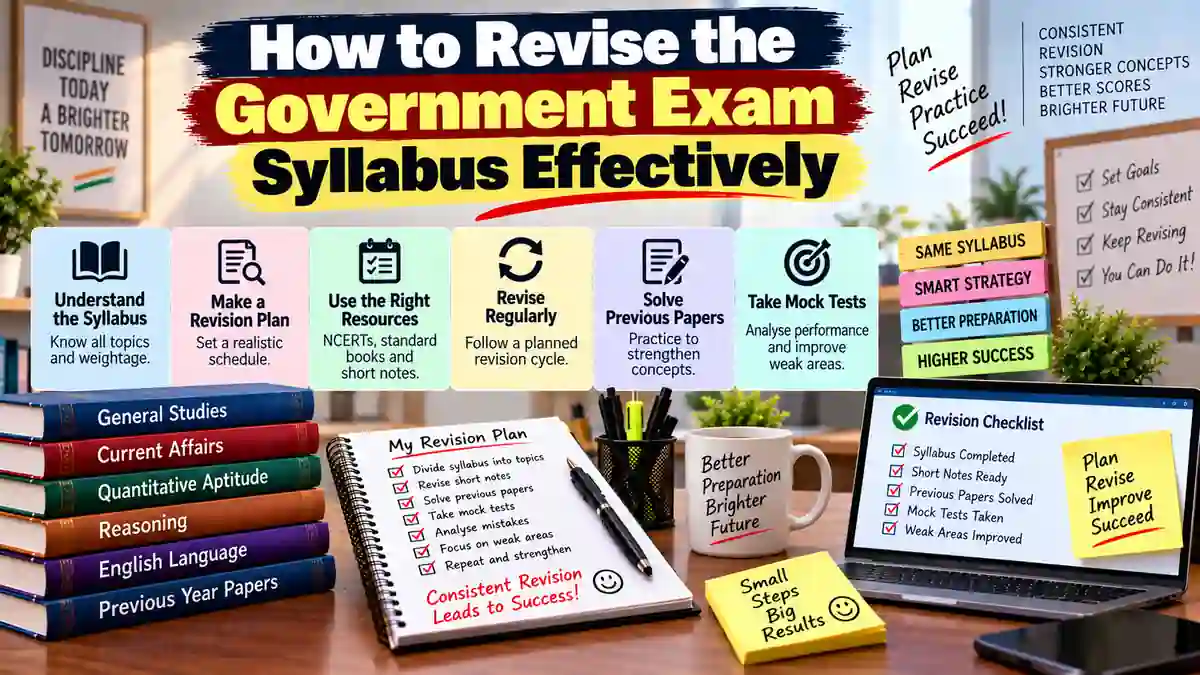
Revision becomes much more useful when it is planned around what you already know, what you keep forgetting and what the exam is likely to test. Simply reading the same chapters again and again can consume a lot of time without improving recall.
A good revision system should bring completed topics back at regular intervals, test your memory without depending on notes and give extra attention to weak areas. It should also leave enough time for previous-year questions and mock tests.
Start by Dividing the Syllabus
Take the syllabus of your target examination and divide it into subjects and smaller topics. Mark each topic according to your current preparation level.
| Status | Meaning | Action |
|---|---|---|
| Strong | You can solve most questions accurately | Quick revision and periodic testing |
| Average | You understand the topic but make occasional mistakes | Regular revision and practice |
| Weak | You struggle to understand or solve questions | Relearn concepts and practise more questions |
| Not Started | The topic has not been prepared yet | Complete basic study before revision |
This simple classification prevents you from spending the same amount of time on every topic.
Do Not Revise the Whole Syllabus Every Day
Trying to revise everything daily can make revision exhausting. Instead, divide the syllabus across the week.
For example, you can assign different days to quantitative aptitude, reasoning, English, general awareness and other subjects included in your examination. Weak topics can receive additional sessions.
The schedule should be flexible enough to change when mock-test results reveal a new weakness.
Use Active Recall
Active recall means trying to remember information before looking at the answer or notes. It is more useful than repeatedly reading the same material because it forces you to retrieve the information from memory.
For example, instead of reading a list of important facts several times, close your notes and try to write or say the facts you remember. Then compare your answers with the original notes.
You can use active recall for:
- Formulas
- Grammar rules
- Important facts
- Dates and events
- Definitions
- Vocabulary
- Constitutional provisions
- Scientific concepts
Use Spaced Revision
Do not leave a completed topic untouched for several weeks. Bring it back into your study schedule at increasing intervals.
A simple revision cycle could look like this:
| Revision | Approximate Timing |
|---|---|
| First revision | Within 1–2 days |
| Second revision | About a week later |
| Third revision | After another 2–3 weeks |
| Final revision | Close to the examination |
These intervals do not have to be followed rigidly. Difficult topics may need more frequent revision, while strong topics can be reviewed less often.
Make Short Revision Notes
Your revision notes should be shorter than your original study material. If your notes are almost as long as the textbook or class material, revision will remain time-consuming.
Keep only information that you are likely to forget or need to recall quickly.
Useful items include:
- Important formulas
- Grammar rules
- Frequently confused facts
- Important dates and events
- Difficult vocabulary
- Common question patterns
- Personal mistakes
Use your own words whenever possible. Notes created during your preparation are usually easier to understand during the final revision.
Revise Through Questions
Revision should not consist entirely of reading. Questions are one of the quickest ways to discover whether you actually remember a topic.
After revising a chapter, solve a short set of questions without looking at your notes. If you perform poorly, return to the relevant concept instead of simply memorising the correct answers.
This method is particularly useful for quantitative aptitude, reasoning, English grammar and general knowledge.
Keep a Separate Mistake List
Your mistakes are valuable revision material. Maintain a list of questions or concepts that you repeatedly get wrong.
For every mistake, try to identify the reason:
- Did you forget a fact?
- Did you misunderstand the concept?
- Did you apply the wrong formula?
- Did you misread the question?
- Was it a calculation error?
- Did you run out of time?
Review this list regularly. A short list of your recurring mistakes can be more useful than rereading an entire book.
Revise Each Subject Differently
Every subject does not need the same revision method.
Quantitative Aptitude
Revise formulas briefly and spend more time solving questions. Focus on calculation speed, common question patterns and mistakes from previous practice.
Reasoning
Practise mixed question sets and revise the solving approaches for topics such as puzzles, seating arrangements, coding-decoding, syllogisms and series. Speed improves through repeated exposure to similar patterns.
English
Revise grammar rules, vocabulary and your common errors. Include reading comprehension, error detection, cloze tests and other question types relevant to your exam.
Gujarati or Hindi
Revise grammar, vocabulary, spelling, idioms, comprehension and other topics included in the language syllabus. Previous-year questions can show which areas need additional attention.
General Awareness
Use short notes, topic-wise revision and regular self-testing. Separate static subjects from current affairs so that your revision remains organised.
Use Previous-Year Papers During Revision
Previous-year papers are not only useful at the end of preparation. They can be used as revision tests after completing individual sections.
When you solve an older paper, note which topics caused difficulty. Then revise those specific topics instead of revising the entire subject from the beginning.
This also helps you recognise the difference between knowing a topic and being able to answer questions based on it.
Include Mock Tests in the Revision Plan
As the exam gets closer, mock tests should become an important part of revision. A mock test brings multiple subjects together and shows whether you can recall information under time pressure.
Do not take a mock test and immediately move on to the next one. Spend time analysing the result.
Check:
- Questions answered incorrectly
- Questions left unanswered
- Questions that took too much time
- Topics where mistakes were repeated
- Questions that you guessed correctly
Questions you guessed correctly deserve attention too because the correct answer may not have been based on reliable knowledge.
Use the 3-Level Revision Method
A practical way to organise revision is to use three levels.
Level 1: Quick Revision
Review formulas, notes, important facts and key rules. This should be relatively fast.
Level 2: Question Practice
Solve topic-wise and mixed questions without referring to your notes. This tests whether you can actually use what you revised.
Level 3: Weak Area Revision
Return only to the concepts and question types where your performance was poor. This prevents strong topics from consuming all your study time.
Plan Weekly Revision Sessions
Keep at least one session every week for reviewing previously completed topics. This protects older material from being forgotten while you focus on new chapters.
A simple weekly structure might look like this:
| Day | Revision Focus |
|---|---|
| Monday | Quantitative aptitude and formulas |
| Tuesday | Reasoning and previous-year questions |
| Wednesday | English or regional language |
| Thursday | General awareness and static topics |
| Friday | Weak topics from the week's practice |
| Saturday | Mixed question practice |
| Sunday | Mock test and detailed analysis |
This is only a sample structure. Your actual schedule should follow the subjects and weightage of your target examination.
Do Not Ignore Topics You Already Know
Strong topics require less time, but they still need periodic revision. Otherwise, information that seemed familiar during preparation may become difficult to recall later.
Use short revision sessions for strong areas rather than spending hours relearning them.
Use the Final Weeks Differently
As the examination approaches, reduce the amount of completely new material you introduce unless there is a specific reason to study it.
Give more attention to:
- Short notes
- Important formulas
- Previous-year papers
- Mistake notebooks
- Mock tests
- Frequently tested topics
- Weak areas identified through practice
The final stage should be about improving recall and exam performance rather than trying to memorise an unlimited amount of new information.
How to Revise When You Have Very Little Time
If only a few days are left, do not attempt to reread every chapter. Prioritise material that can realistically improve your score.
- Review your short notes.
- Revise frequently forgotten formulas and facts.
- Go through your mistake list.
- Solve selected previous-year questions.
- Take timed practice tests.
- Review weak topics identified from those tests.
A focused revision session is usually more productive than rushing through multiple books without testing your recall.
Common Revision Mistakes
- Reading notes repeatedly without testing memory.
- Revising only favourite subjects.
- Ignoring weak topics because they are difficult.
- Making extremely long revision notes.
- Leaving previous-year questions until the final days.
- Taking mock tests without analysing mistakes.
- Trying to learn too much new material just before the exam.
- Not revising topics that were completed several weeks earlier.
A Practical Daily Revision Routine
If most of your syllabus is already completed, a daily revision session can be divided into three parts.
| Session | Focus |
|---|---|
| Session 1 | Quick revision of notes, formulas and important facts |
| Session 2 | Topic-wise or mixed question practice |
| Session 3 | Mistake analysis and revision of weak areas |
On mock-test days, replace one practice session with a full test and reserve enough time afterward for analysis.
Track Your Revision Progress
Keep a simple checklist of the syllabus and update it after every revision cycle. Mark topics as revised, tested and needing additional work.
You can also track your mock-test scores over time. A single low score does not necessarily indicate poor preparation. Look for the trend and identify whether accuracy, recall and time management are improving.
Effective syllabus revision is less about reading more and more material and more about recalling, testing and correcting. Divide the syllabus into manageable topics, revise at spaced intervals, practise previous-year questions, maintain a mistake list and use mock tests to identify what needs attention. The closer you get to the exam, the more your revision should focus on high-value notes, repeated mistakes and actual question practice rather than covering large amounts of new material.