Common Mistakes Government Job Aspirants Should Avoid
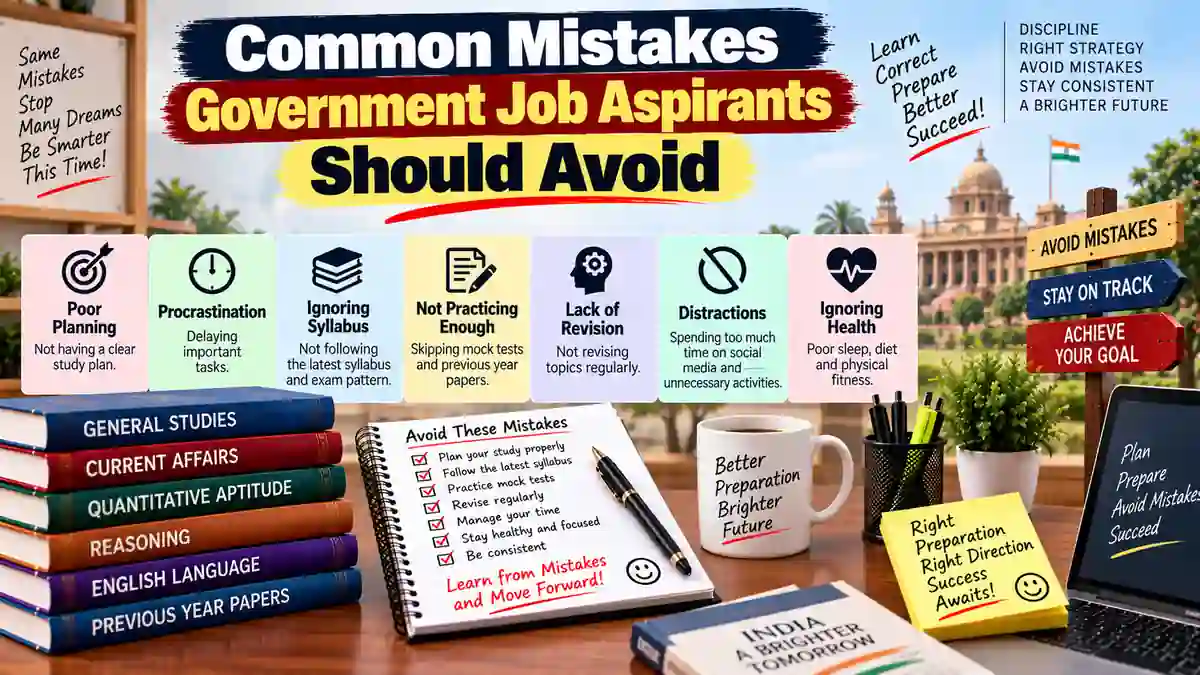
Many government job aspirants spend months studying but still struggle to improve their exam performance. The problem is not always a lack of effort. In many cases, the preparation method itself needs to change.
Some mistakes are small, such as ignoring an application deadline. Others can affect months of preparation, such as repeatedly changing the target exam or spending too much time collecting study material instead of solving questions.
1. Preparing Without Choosing a Clear Target
Keeping every government exam as an option may sound safe, but it can make preparation directionless.
Different examinations can have different syllabi, difficulty levels, selection stages and job profiles. If you keep switching between them, you may never develop enough depth in any one preparation plan.
Choose a primary examination based on your qualification, career preference and preparation level. You can keep compatible exams as backups when their syllabi overlap. See how to choose the right government exam for your career before finalising your target.
2. Starting Without Checking the Official Syllabus
One of the most avoidable mistakes is beginning preparation from random books or online videos without first checking the syllabus.
The official syllabus gives you a boundary for your preparation. Without it, you may spend considerable time studying topics that are not relevant to your examination.
Before starting, make a topic checklist and mark each area as completed, in progress or pending.
3. Ignoring the Actual Job Profile
Some candidates choose an examination only because they have heard that the job has a good salary or reputation.
That can create problems later. Government jobs can involve office work, field duties, public dealing, technical responsibilities, transfers or physical requirements depending on the post.
Before investing months in preparation, spend some time understanding the type of work associated with the posts you are targeting.
4. Trying to Prepare for Too Many Exams
Applying for several compatible examinations can be useful. Preparing separately for every examination is a different matter.
If five exams require five unrelated syllabi, dividing your time between all of them can leave you underprepared for each.
A better approach is to identify exams with substantial syllabus overlap and treat them as one common preparation base with additional exam-specific work. If you are targeting multiple compatible exams, read how to prepare for multiple government exams.
5. Collecting Too Many Books and Courses
More study material does not automatically mean better preparation.
A common pattern is to buy one book, start an online course, download several PDFs and then switch to another teacher when a new recommendation appears. Eventually, several resources remain unfinished.
Choose a limited set of reliable resources and complete them before adding more. Use additional sources mainly when a particular concept is difficult to understand.
6. Spending Too Much Time Watching Classes
Watching a lecture can create the feeling that you have studied a topic even when you have not tested your understanding.
After learning a concept, solve questions without looking at the solution. If you cannot apply the concept, go back and review it.
A useful preparation cycle is:
- Learn the concept.
- Solve practice questions.
- Check mistakes.
- Revise the weak area.
- Test yourself under a time limit.
7. Avoiding Previous-Year Papers
Previous-year papers are one of the best ways to understand what your examination actually asks.
They can show you:
- Frequently tested topics
- Typical question difficulty
- Question formats
- Time pressure
- Areas where your preparation is weak
Do not wait until the final weeks to look at previous-year papers. Use them while preparing so that your study remains connected to the actual examination.
For a practical method, see how to use previous-year papers for government exam preparation.
8. Taking Mock Tests Without Analyzing Them
Taking a large number of mock tests is not enough. The analysis after the test is where much of the learning happens.
After every important mock, check why you lost marks.
| Problem | What to Work On |
|---|---|
| Conceptual mistake | Revise the topic and solve additional questions |
| Calculation mistake | Improve calculation accuracy and slow down slightly |
| Question took too long | Practice faster methods and question selection |
| Question was unfamiliar | Study the underlying concept or question type |
| Ran out of time | Work on section strategy and time management |
If you want to improve your analysis process, read how to analyze your government exam mock test score.
9. Focusing Only on Study Hours
Writing "10 hours" in a study tracker does not necessarily mean ten productive hours.
Instead of measuring preparation only by time, track useful outputs such as:
- Topics completed
- Questions solved
- Accuracy percentage
- Mock-test performance
- Revision completed
- Repeated mistakes reduced
A focused four-hour study session can be more productive than a distracted eight-hour day.
For a realistic approach to daily study time, see how many hours you should study for a government exam.
10. Ignoring Weak Subjects
It is easy to keep studying subjects you enjoy because the work feels comfortable. The subjects you dislike are often left for later.
This can create a major weakness in the final score.
Keep practicing your strong subjects so that you do not lose your advantage, but give additional time to the topics that are consistently reducing your marks.
You can use this method to identify weak subjects before a government exam.
11. Trying to Finish the Syllabus Without Revision
Completing a chapter once does not mean you will remember it during the examination.
Without revision, formulas, rules, facts and problem-solving methods can become difficult to recall.
Build revision into your weekly routine. Maintain short notes for competitive exam preparation for topics that require frequent review and keep a separate record of repeated mistakes.
12. Leaving Current Affairs Until the Last Moment
For examinations where current affairs are relevant, postponing everything until the final weeks can create a large revision burden.
Choose a reliable source and follow it consistently. Keep your notes concise enough to revise rather than collecting every piece of news you come across.
The exact period and type of current affairs required should be decided from the examination's syllabus, previous papers and official requirements.
For a more structured approach, see how to study current affairs for government exams.
13. Ignoring Time Management Until the Exam
Knowing how to solve a question and solving it quickly enough in the examination are different skills.
Start timed practice after your basic concepts become reasonably strong. Gradually move from topic-wise time limits to sectional tests and eventually full-length mocks.
Learn which questions should be attempted immediately and which ones should be skipped and revisited later, according to the examination's rules.
You can also read how to manage time during a government competitive exam.
14. Chasing Shortcuts Before Learning the Basics
Short tricks can save time, but they are not a substitute for understanding the underlying method.
If you depend entirely on shortcuts without understanding the concept, an unfamiliar question can become difficult.
Learn the standard method first. Once the concept is clear, use shortcuts where they genuinely improve speed without reducing accuracy.
15. Not Checking Eligibility Properly
Do not assume that being a graduate or 12th-pass candidate automatically makes you eligible for every examination at that level.
Recruitments can specify particular subjects, technical qualifications, age conditions, experience requirements or other criteria.
Read the current official notification carefully before applying. You can also use government jobs based on your qualification as a starting point when exploring suitable recruitment categories.
16. Missing Application Deadlines
Months of preparation cannot help if you miss the application window.
When you decide to target an examination, record:
- Application start date
- Application closing date
- Fee payment deadline where applicable
- Correction window, if provided
- Expected examination stages
Check the recruiting authority's official website for updates instead of depending entirely on social media posts or old videos.
You can also keep track of new recruitment through the latest job updates section.
17. Making Mistakes While Filling the Application Form
Application forms should be completed carefully. Small errors in personal information, qualification details, uploaded documents or selected preferences can create avoidable problems.
Before final submission, review the complete form and compare the entered information with your original documents.
Keep copies of the submitted application, payment confirmation and important registration details where appropriate.
For more guidance, see common mistakes while filling government job forms and how to correct mistakes in a government job application form.
18. Ignoring Document Requirements
Do not wait until document verification to discover that an important certificate is unavailable or outdated.
Depending on the recruitment, candidates may need educational certificates, identity documents, photographs, signatures, category certificates or other supporting documents.
The exact requirements differ by recruitment, so follow the current notification rather than using a generic document list from an old recruitment.
See documents required for a government job online application for a useful checklist.
19. Neglecting Skill or Physical Tests
Some candidates concentrate entirely on the written examination even when the recruitment includes another qualifying or competitive stage.
If the selection process includes typing, computer skills, physical efficiency, physical standards, driving or another specific requirement, include that preparation early enough.
Do not assume that a strong written score will remove the need to meet other mandatory selection conditions.
For physical-test preparation, see how to prepare for a government job physical test.
20. Comparing Your Preparation With Other Aspirants
Comparing study hours, mock scores or the number of books completed can create unnecessary pressure.
Another candidate may have stronger fundamentals, more preparation time or a different target examination.
Use your own previous performance as the main comparison. If your accuracy is improving and repeated mistakes are decreasing, your preparation is moving in the right direction.
21. Changing Strategy After Every Low Mock Score
A poor mock score does not necessarily mean your entire preparation strategy is wrong.
First identify the reason for the score. If the problem is limited to a few weak topics, fix those topics rather than changing books, teachers and timetables completely.
Look at performance across several tests before making major changes.
See what to do if your mock test scores are not improving before making a major change to your preparation plan.
22. Ignoring Sleep and Breaks
Long preparation periods require a routine that you can sustain. Regularly cutting sleep to create additional study hours can affect concentration and the quality of your practice.
Use planned breaks between study sessions and maintain a reasonable daily routine. Your goal is consistent preparation over months, not an exhausting schedule that lasts for a few days.
23. Depending on Unverified Information
Government recruitment information spreads quickly through social media, messaging groups and short videos. Some of it can be outdated or incomplete.
For important details such as eligibility, dates, vacancies, syllabus, selection stages and document requirements, verify the information against the official recruitment notification or recruiting authority website.
24. Preparing Only for the Written Exam
A recruitment process can have several stages. Depending on the post, these may include skill tests, physical tests, interviews, document verification or medical requirements.
Understand the complete selection process before starting preparation. This helps you avoid reaching one stage and discovering that another required skill has been neglected.
You can also read what happens after clearing a government job exam to understand the stages that may follow the written examination.
A Simple Way to Correct These Mistakes
You do not need to completely rebuild your preparation every time you identify a problem. Start with a simple weekly review.
| Question | What to Check |
|---|---|
| Did I follow the syllabus? | Check completed and pending topics |
| Did my accuracy improve? | Compare recent practice and mock results |
| What mistakes keep repeating? | Review your error notebook |
| Am I spending time effectively? | Check actual study output, not only hours |
| Is my target still suitable? | Review the job profile and recruitment requirements |
| Are upcoming deadlines under control? | Check applications and official updates |
Focus on Fewer Mistakes, Not Just More Study
Government exam preparation becomes much more manageable when you remove the habits that waste your time.
Choose your target carefully, follow the official syllabus, keep your resources under control and practice previous-year questions regularly. Use mock tests to identify weaknesses rather than simply collecting scores, and make revision part of your normal routine.
Most importantly, do not confuse activity with progress. Finishing another video or studying for another hour matters only when it improves your knowledge, accuracy, speed or exam readiness.