How to Set Realistic Goals for Government Job Preparation
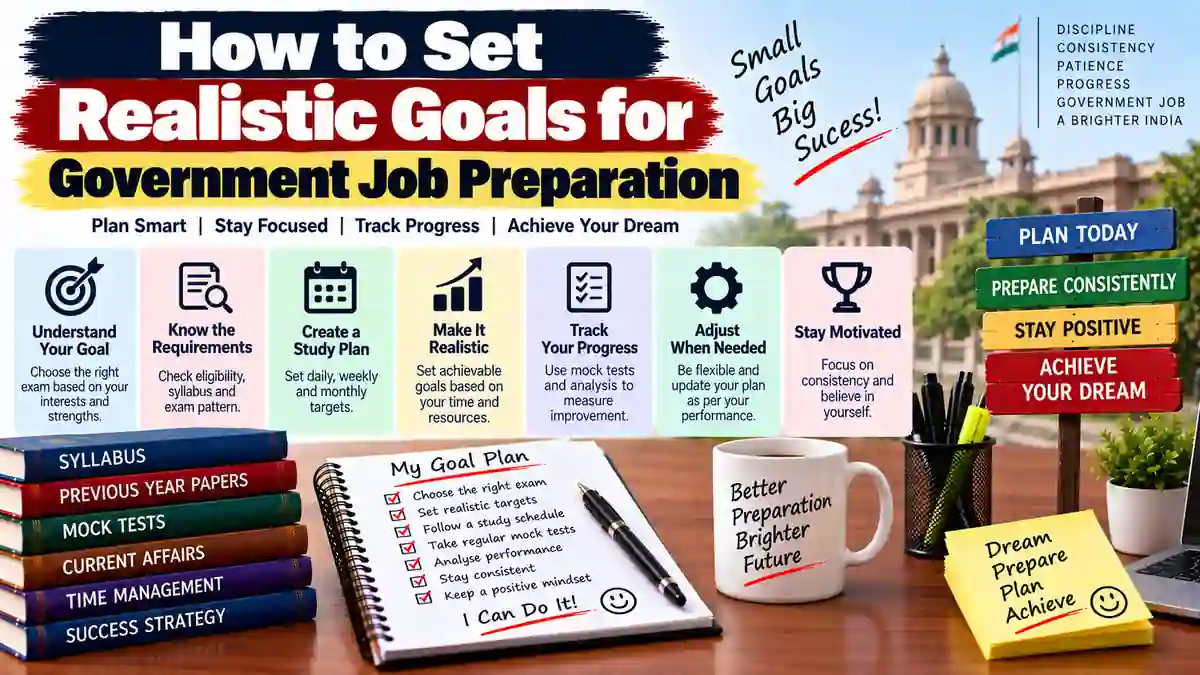
Government exam preparation can easily become frustrating when the target is simply “I need to clear the exam.” The final result is not completely under your control, but your daily study, practice, revision, mock tests and application of feedback are. Setting smaller and measurable goals makes preparation easier to manage and gives you a clearer idea of whether you are actually improving.
Start With the Actual Examination
Before setting a study target, decide which government examination or group of examinations you are preparing for. Your goal should be connected to a specific syllabus and selection process.
Check the official recruitment information for:
- Educational eligibility
- Age limit
- Exam pattern
- Syllabus
- Number of stages
- Marking scheme
- Negative marking, if applicable
- Skill, physical or interview requirements
- Important recruitment dates
Without knowing these details, it is difficult to create a realistic preparation target. If you are still deciding which examination is suitable for you, you can first read how to choose the right government exam.
Do Not Make “Get a Government Job” Your Only Goal
Getting selected is the final outcome, but it is not a useful daily target because you cannot directly control the final merit list.
Instead, divide the larger objective into smaller goals:
| Long-Term Goal | Short-Term Goal |
|---|---|
| Clear the examination | Complete the syllabus |
| Improve examination score | Increase mock-test score gradually |
| Improve accuracy | Reduce repeated mistakes |
| Improve speed | Complete timed practice sets |
| Remember important topics | Follow a regular revision cycle |
This gives you things you can actually work on every day.
Set a Clear Target for Your Preparation
A useful preparation goal should answer four questions:
- What? What exactly will you complete?
- How much? How many topics, questions or tests?
- When? By what date or time?
- How will you measure it? How will you know that the target is complete?
For example, “I will study reasoning” is too broad. “I will complete syllogism, coding-decoding and blood-relation questions and solve 100 practice questions by Sunday” is much easier to measure.
Break the Syllabus Into Smaller Parts
A large syllabus can look overwhelming when viewed as one list. Divide it into subjects, chapters and individual topics.
| Level | Example |
|---|---|
| Subject | Quantitative Aptitude |
| Topic | Percentage |
| Subtopic | Increase and decrease |
| Practice Target | 50 questions |
| Performance Target | Improve accuracy after reviewing mistakes |
This makes it easier to see actual progress instead of simply saying that you have been studying for several hours. A structured government job exam study plan can help turn these smaller targets into a practical routine.
Set Weekly Goals Before Daily Goals
Daily schedules can change because of college, work, family responsibilities or unexpected events. A weekly target gives you some flexibility.
For example, your weekly target could include:
- Three quantitative aptitude topics
- Two reasoning topics
- Two English practice sessions
- Five current-affairs revision sessions
- One previous-year paper
- One full mock test
- Review of mistakes from the week's practice
You can distribute these tasks across the week according to your available time. If you need a more detailed daily structure, see this government exam study timetable.
Set Daily Study Targets You Can Actually Complete
One of the most common preparation mistakes is creating a timetable that looks impressive but cannot be followed for more than a few days.
If you currently study three hours a day, suddenly planning ten hours every day may not be realistic. Increase your study time gradually if your schedule allows it.
A practical daily target can combine time and output:
- 2 hours of concept study
- 1 hour of question practice
- 30 minutes of revision
- 30 minutes of error analysis
The exact numbers should depend on your circumstances. The important part is that the plan can be repeated consistently. You can also read how many hours to study for a government exam for a practical approach to managing study time.
Do Not Measure Preparation Only by Study Hours
Two people can study for the same number of hours and make very different progress. Hours are useful for planning, but completed work and performance provide better feedback.
| Weak Target | Better Target |
|---|---|
| Study for 5 hours | Complete two topics and solve 80 questions |
| Read current affairs | Revise one week's current affairs and test yourself |
| Practise maths | Complete 40 timed arithmetic questions |
| Prepare reasoning | Complete one topic and analyse incorrect questions |
Set a Syllabus Completion Deadline
Give yourself a realistic date by which you want to complete the first full coverage of the syllabus.
Do not set the deadline so close that you have no time for revision. At the same time, avoid keeping the syllabus open-ended for months without a completion target.
Once the first coverage is complete, shift more time toward revision, previous-year papers and mock tests. The government exam syllabus revision guide can help you structure this stage.
Leave Time for Revision
Finishing a topic once does not mean that preparation for that topic is complete. Government exam preparation involves remembering concepts, formulas, vocabulary, facts and question-solving methods over time.
A simple approach is to schedule:
- Short revision soon after learning a topic
- Another revision after several days
- Periodic revision of older topics
- Full revision before the examination
The exact interval can vary depending on the subject and how well you remember it. Making short notes for competitive exam preparation can also make repeated revision easier.
Set Mock Test Goals
Mock tests should be used to measure preparation, not simply to increase the number of tests completed.
Instead of saying “I will take 30 mocks,” set goals such as:
- Complete one full mock every week initially.
- Review every incorrect answer.
- Identify questions that consumed too much time.
- Track your score and accuracy.
- Increase test frequency as the examination approaches.
The appropriate number of mock tests depends on the examination, your preparation level and the time available. Read how many mock tests to attempt before a government exam for more guidance.
Set a Score Target Carefully
It is useful to have a target score, but do not treat an expected cut-off as a guaranteed number. Cut-offs can change according to the examination, vacancies, candidate performance, difficulty level and selection rules.
Instead of preparing merely to reach last year's cut-off, aim to build a reasonable margin above it while continuing to improve your accuracy and speed. You can understand the factors behind changing marks through this guide to how government exam cut-offs are calculated.
Track Accuracy, Not Just Marks
A high number of attempts does not necessarily mean a strong performance. In examinations with negative marking, careless answers can reduce your score.
| Metric | What It Tells You |
|---|---|
| Attempts | How many questions you tried |
| Correct Answers | Quality of your attempts |
| Incorrect Answers | Potential accuracy problem |
| Time Taken | Speed and question-selection efficiency |
| Score | Overall mock-test performance |
Review all five rather than focusing only on the final score. You can also learn how to improve speed and accuracy in competitive exams.
Set Subject-Wise Goals
Do not assume that every subject needs the same amount of study time. Your weaker subjects may require more practice, while stronger subjects may need regular revision to maintain performance.
For example, if your reasoning accuracy is already strong but quantitative aptitude is weak, spending equal hours on both subjects may not be the best use of your available time.
Identify Your Weak Areas
Use practice tests and previous-year papers to identify specific weaknesses.
Instead of writing “Maths is weak,” identify the actual problem:
- Percentage questions take too long.
- Calculation mistakes occur in arithmetic questions.
- Geometry concepts are unclear.
- Data interpretation takes too much time.
A specific problem is much easier to turn into a specific goal. This guide to identifying weak subjects before a government exam can help you make that assessment more systematic.
Use a Priority System
You do not have to treat every topic equally. Divide topics into three groups:
| Priority | Meaning | Action |
|---|---|---|
| High | Important and weak | Give regular study and practice time |
| Medium | Important but reasonably comfortable | Practise and revise regularly |
| Low | Less important or already strong | Maintain with occasional revision |
The exact priority should be based on your examination syllabus and previous papers.
Set Goals for Previous-Year Papers
Previous-year papers are one of the most useful tools for understanding the actual examination. Set a target for completing them under realistic time conditions. You can also follow this guide on using previous-year papers for government exam preparation.
After solving a paper, do not immediately move to the next one. Analyse:
- Questions you got wrong
- Questions you guessed
- Questions that took too long
- Topics you had forgotten
- Questions you skipped unnecessarily
The analysis is often more valuable than simply counting how many papers you completed.
Keep a Mistake Notebook
Maintain a small record of recurring mistakes. It can contain formulas you repeatedly forget, grammar errors, reasoning patterns, calculation mistakes or questions you misunderstood.
Review this record regularly. If the same mistake appears repeatedly, turn it into a specific improvement goal.
Do Not Compare Your Daily Progress With Someone Else
Government exam aspirants often compare study hours, mock scores and completed chapters with friends or people on social media. Such comparisons can create unnecessary pressure because everyone's starting level, schedule and target examination can be different.
Compare your current performance with your own previous performance. A gradual improvement in accuracy or mock scores is more useful than matching someone else's timetable.
Keep Your Goals Flexible
A realistic goal is not one that can never change. If a particular topic takes longer than expected, adjust the schedule without abandoning the entire plan.
For example, if you planned to complete five topics in a week but two difficult topics require additional practice, move the remaining topics into the following week and protect your revision time.
The goal is to maintain steady progress rather than complete every timetable exactly as originally written.
Review Your Progress Every Week
Spend a few minutes at the end of each week reviewing your actual progress.
| Question | Your Review |
|---|---|
| How many planned topics were completed? | ________________ |
| How many questions were practised? | ________________ |
| How many mocks were completed? | ________________ |
| What was the average accuracy? | ________________ |
| Which topic remained weak? | ________________ |
| What should change next week? | ________________ |
This weekly review prevents you from following an ineffective timetable for several months.
Set Goals for the Final Month
When the examination is close, your goals should change. The focus should gradually move away from learning everything for the first time and toward revision, timed practice and exam strategy.
- Complete remaining high-priority topics.
- Revise completed subjects.
- Solve previous-year papers.
- Take regular full-length mocks.
- Analyse mistakes after every test.
- Improve time management.
- Reduce careless errors.
Set Goals for the Final Week
The final week is not the time to create an unrealistic target such as learning the entire syllabus again.
Focus on:
- Revision of important topics
- Previously identified weak areas
- Important formulas and facts
- Selected practice questions
- Light mock or sectional practice as appropriate
- Exam-day documents and arrangements
- A normal sleep routine
For practical exam-day preparation, you can also review this government exam day preparation checklist.
Examples of Realistic Government Exam Goals
| Time Period | Example Goal |
|---|---|
| Today | Complete one topic and solve 50 related questions |
| This Week | Complete three priority topics and one previous-year paper |
| This Month | Complete the first coverage of selected subjects and begin regular mocks |
| Next 2–3 Months | Complete syllabus coverage, revision and structured mock-test practice |
| Final Weeks | Focus on revision, accuracy, timing and examination strategy |
What to Do When You Miss a Goal
Missing one day's target does not mean that your preparation has failed. Avoid trying to compensate by creating an extreme workload for the next day.
Instead, identify why the target was missed. Perhaps the target was too large, the topic was more difficult than expected, or another responsibility reduced your available time.
Adjust the next target accordingly and continue.
Goals Should Become More Specific as the Exam Gets Closer
Early in preparation, goals can focus on learning and syllabus coverage. Later, they should become more focused on performance.
| Preparation Stage | Main Goal |
|---|---|
| Beginning | Understand the syllabus and build basic concepts |
| Middle | Complete topics and increase question practice |
| Practice Stage | Improve accuracy and speed through timed tests |
| Final Stage | Revise, practise full papers and reduce avoidable mistakes |
| Exam Week | Stay prepared, rested and organised |
Do Not Set Unrealistic Targets
Some common targets look motivating but are difficult to sustain:
- Studying 12 to 15 hours every day without considering your current routine.
- Completing hundreds of questions without analysing mistakes.
- Finishing an entire syllabus in an unnecessarily short period.
- Taking multiple mock tests every day while ignoring revision.
- Trying to master every subject equally regardless of your weaknesses.
A smaller target that you consistently complete is more useful than a large target that you repeatedly abandon. If you are struggling with your mock-test performance, see what to do if your mock test scores are not improving.
Build a Goal System You Can Maintain
A practical government exam preparation plan should connect your long-term objective with weekly and daily actions. Choose the examination, divide the syllabus, set realistic deadlines, track your practice and use mock-test results to adjust your strategy. For a broader preparation framework, you can also refer to the government job preparation strategy.
Do not judge your preparation only by how many hours you sit at a desk. Look at what you have completed, how accurately you can solve questions, how quickly you can work and whether your mock-test performance is improving.
Your final selection will depend on the competition and the rules of the recruitment, but a well-planned preparation system gives you much more control over the part that is actually in your hands.