How to Select Government Jobs With Better Career Growth
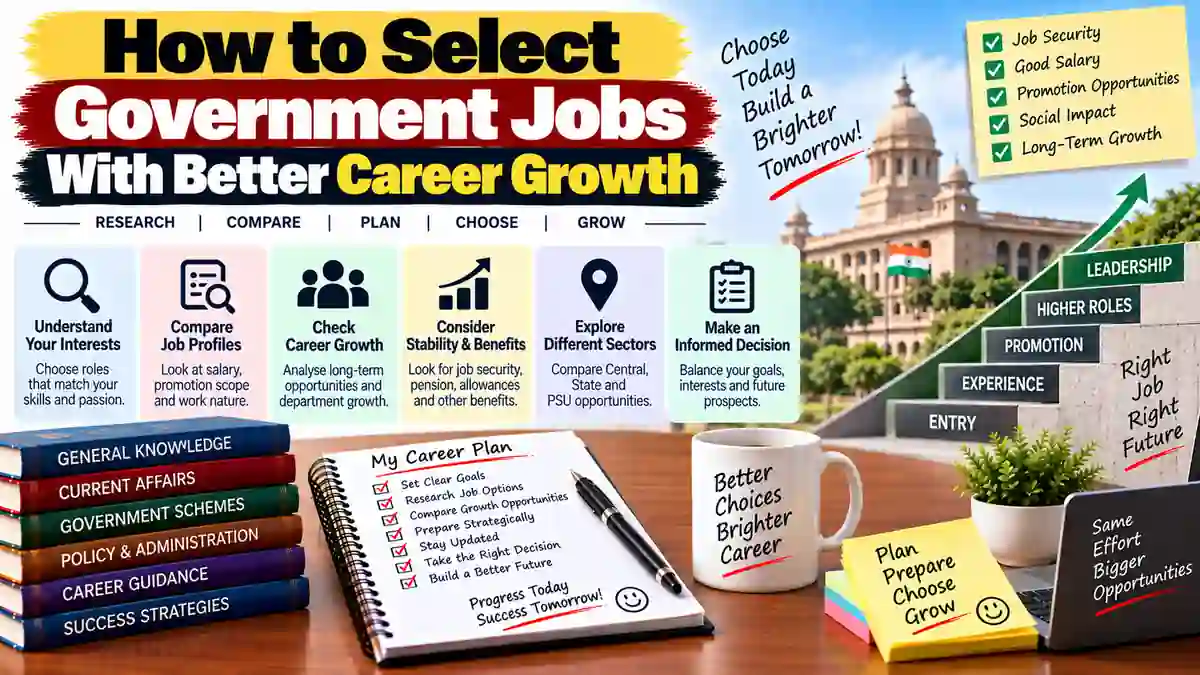
A government job should not be judged only by its starting salary or the popularity of the post. Two jobs with similar starting pay can offer very different career paths over the next 10, 20 or 30 years.
When comparing government jobs, look beyond the first appointment. Check the promotion structure, nature of work, department, responsibilities, transfer policy, opportunities for departmental advancement and how the role fits your long-term career plans.
If you are still deciding which examination to prepare for, it is also useful to first understand how to choose the right government exam based on your qualification, interests and career objectives.
What Does Career Growth Mean in a Government Job?
Career growth is not limited to getting a higher salary. In government employment, growth can happen through promotions, higher responsibilities, changes in designation, departmental examinations, seniority-based progression and movement into more specialized or supervisory roles.
A useful comparison should therefore consider several factors:
- Starting pay
- Promotion opportunities
- Time normally required for progression
- Number of higher posts available
- Nature of responsibilities
- Departmental career structure
- Scope for specialization
- Transfer and posting requirements
- Work-life considerations
- Long-term earning potential
The exact promotion rules depend on the department, cadre, recruitment rules and post. Therefore, avoid assuming that a particular designation always has the same career path across different departments.
Start With the Job Role, Not Just the Job Title
A designation can sound attractive while the actual work may be very different from what you expect. Before selecting an examination, find out what the employee actually does after joining.
Look at:
- Daily responsibilities
- Office-based or field-based work
- Public dealing requirements
- Technical responsibilities
- Supervisory responsibilities
- Administrative work
- Working hours and operational requirements
- Possibility of postings in different locations
For example, a candidate who prefers technical work may be unhappy in a role that is mostly administrative, even if the salary and designation look attractive. Similarly, someone who wants a field-oriented career may not enjoy a position that involves mostly desk work.
Career growth is more useful when it occurs in a type of work you can realistically see yourself doing for many years.
Check the Promotion Structure
Promotion is one of the most important factors when comparing government jobs for long-term growth.
Try to find out what happens after the initial appointment. A typical career structure may involve movement from an entry-level position to higher grades, supervisory positions and eventually senior administrative or specialized posts, depending on the service.
Do not judge promotion opportunities solely from the names of senior posts. Check whether those posts actually form part of the same cadre or service and what rules govern advancement.
| Promotion Factor | What to Check |
|---|---|
| First promotion | Eligibility conditions and applicable service requirements |
| Higher posts | How many levels of progression are available |
| Promotion method | Whether progression involves seniority, departmental selection, examination or other conditions |
| Vacancies | Whether higher positions have sufficient vacancies for progression |
| Cadre structure | Whether the higher post belongs to the same career hierarchy |
Promotion can depend on vacancies and departmental rules, so a theoretical promotion hierarchy should not be treated as a guaranteed timeline.
Do Not Choose a Job Only Because Its Starting Salary Is Higher
Starting salary matters, but it is only one part of a long government career.
Suppose Job A starts with a slightly higher salary but has limited progression, while Job B starts somewhat lower but provides several opportunities to move into higher grades. Looking only at the first month's salary could lead to the wrong decision.
Compare the overall career path instead:
- Initial pay level
- Allowances applicable to the post
- Future pay progression
- Promotion opportunities
- Responsibilities at higher levels
- Possibility of moving into specialized roles
Actual salary and allowances vary according to the applicable pay structure, department, posting and rules. Always use the recruitment notification and applicable government rules when comparing specific posts.
Look at the Department's Career Structure
The department itself can have a major influence on career progression. Some organizations have a large hierarchy with many levels, while others have fewer positions above the entry level.
A large department may offer several types of assignments and opportunities for specialization. A smaller organization may offer a more limited hierarchy but could provide a different type of work or posting environment.
Before selecting an examination, research:
- The department or organization recruiting for the post
- The cadre or service to which the post belongs
- Higher designations within that structure
- Departmental promotion rules
- Whether employees can move into other roles within the service
- Whether departmental examinations are relevant
This is especially useful when two examinations appear similar on paper but lead to very different career paths.
Consider Departmental Examinations and Internal Opportunities
Some government services provide opportunities for employees to progress through departmental examinations or internal selection processes. Where such mechanisms exist, they can become an important part of career planning.
However, the availability and rules differ by service. Do not assume that every government employee can take the same type of departmental examination.
When reading recruitment or service information, look for provisions relating to:
- Departmental examinations
- Promotion examinations
- Internal selection
- Limited departmental competitive examinations
- Eligibility for higher posts
- Required years of service
Understanding these options can help you distinguish between a job that offers only routine progression and one with multiple routes for advancement.
Compare Career Growth With Your Qualification
Your educational qualification should influence the type of government career you target. A candidate with a technical or professional qualification may have opportunities in specialized government services that are not available to candidates applying for general posts.
If you are a graduate, for example, you can compare general administrative, banking, railway, staff-selection and other graduate-level opportunities instead of applying randomly to every vacancy. You can use this guide on government jobs after graduation to explore the broader options before narrowing your target.
Similarly, candidates with qualifications at the 10th or 12th level can first understand the relevant opportunities through guides covering government jobs after 10th and government jobs after 12th.
Check Whether Your Age Gives You Enough Time for Growth
Age matters in government recruitment because each examination has its own eligibility rules and applicable age cut-off date.
If you are choosing between multiple career paths, consider how much time you potentially have before reaching the applicable retirement age and how that affects the number of years available for progression.
This does not mean older candidates should automatically reject a position with fewer promotion levels. A job can still be a good choice if its responsibilities, stability and other conditions match the candidate's priorities.
The key is to evaluate the complete career rather than only the first appointment.
Consider Transfer and Posting Requirements
Career growth sometimes comes with geographical mobility. Some government positions can involve transfers between districts, states, regions, offices or field locations, depending on the service.
If you have strong family or location preferences, investigate the posting structure before selecting an examination.
| Question | Why It Matters |
|---|---|
| Can the post involve transfers? | It affects long-term location stability. |
| Are postings limited to a region? | A regional cadre may provide a different posting pattern from an all-India service. |
| Are field postings common? | This affects lifestyle and daily work. |
| Can promotion require a transfer? | Higher responsibility may involve a different location. |
Do not assume that a particular recruitment always guarantees a preferred city. Posting conditions should be checked from the relevant service and recruitment rules.
Think About the Work You Will Be Doing at 40
This is an underrated question when selecting a government job.
Many candidates focus heavily on getting the first appointment and give little thought to whether they will enjoy the role after several years.
Ask yourself:
- Would I still be comfortable doing this type of work after 10 years?
- Do I want administrative responsibility?
- Would I prefer technical specialization?
- Am I comfortable dealing with the public?
- Do I prefer office work or field work?
- Would I accept transfers for better career opportunities?
- Do I want a supervisory position in the future?
Your answers can eliminate several jobs that may look attractive when judged only by salary or examination popularity.
Separate Promotion From Salary Increments
A government employee can receive financial progression under applicable rules without necessarily receiving a new designation at the same time. Therefore, promotion and salary growth should not be treated as identical.
When comparing jobs, look separately at:
- Regular pay progression
- Promotional opportunities
- Higher responsibilities
- Changes in designation
- Applicable financial progression mechanisms
This gives you a clearer picture of how the career may develop over time.
Check the Selection Difficulty Against the Career Benefit
A job with excellent long-term prospects may also have a highly competitive selection process. That does not mean you should avoid it, but you should understand the preparation commitment involved.
If you are restarting your preparation, first compare the examination with your present level. You can use this preparation guide for starting government exam preparation from scratch if your fundamentals need rebuilding.
If you are considering two or more related examinations, also understand how much of their syllabus overlaps. Preparing for multiple government exams can work when the examinations share substantial subjects and preparation requirements, but taking on unrelated syllabuses can reduce your focus.
Use Previous-Year Papers to Understand the Actual Examination
Career growth matters only after you successfully enter the service. Before spending months preparing for an examination, look at previous-year papers to understand the level and nature of the selection test.
Previous-year papers can show:
- Frequently tested topics
- Question difficulty
- Time pressure
- Question distribution
- Areas requiring more practice
For a more detailed approach, see how to use previous-year papers for government exam preparation.
Check Whether You Actually Like the Career Path
Popularity is a poor substitute for career fit.
A particular government post may receive a large number of applications because it is widely known. That does not mean it is the best choice for every candidate.
Instead of asking only, "Which government job is best?", ask:
"Which government career gives me a reasonable combination of work I can tolerate or enjoy, career growth, financial stability, location preferences and a selection process I can realistically prepare for?"
This produces a much more useful shortlist.
Create a Government Job Comparison Table
When you have shortlisted three or four posts, write down the major factors instead of keeping everything in your head.
| Factor | Job A | Job B | Job C |
|---|---|---|---|
| Qualification required | Check notification | Check notification | Check notification |
| Starting pay | Compare official details | Compare official details | Compare official details |
| Promotion structure | Research cadre rules | Research cadre rules | Research cadre rules |
| Work profile | Office/field/technical | Office/field/technical | Office/field/technical |
| Transfer possibility | Check service rules | Check service rules | Check service rules |
| Selection stages | Compare | Compare | Compare |
| Preparation difficulty | Assess personally | Assess personally | Assess personally |
| Long-term fit | Rate yourself | Rate yourself | Rate yourself |
The table does not need to be complicated. The purpose is to make the differences visible before you commit months of preparation.
Give More Weight to the Factors You Actually Care About
Not every candidate should use the same ranking system.
For one person, promotion may be the top priority. Another person may value staying close to home. Someone else may prefer technical work, while another candidate may prioritize stable office hours.
You can divide your priorities into three groups:
- Essential: Conditions you cannot compromise on.
- Important: Factors that strongly influence your decision.
- Preferred: Benefits that would be useful but are not essential.
This prevents a small difference in starting salary from overshadowing a factor that matters much more to your long-term satisfaction.
Do Not Assume a Higher Designation Automatically Means Better Career Growth
A higher-sounding designation does not necessarily mean a better career for every person. The actual authority, responsibilities, promotion system, work environment and future opportunities need to be examined.
Similarly, a lower entry-level designation can sometimes provide a strong long-term career path because of its structured promotion system or opportunities within the service.
Always compare the actual service structure rather than relying on informal rankings or social-media lists of "best government jobs."
Use a Long-Term Career Planning Approach
Choosing a government job is easier when you connect the decision to a broader career plan. Consider where you want to be after five years, ten years and beyond the initial appointment.
If you have not already created a broader career plan, government job career planning can help you organize your priorities before selecting a specific examination.
You can also set measurable preparation targets rather than simply deciding to "study more." The guide on setting realistic goals for government job preparation can be useful when converting your chosen career target into practical study goals.
Questions to Ask Before Finalizing Your Target Exam
- Am I eligible for this post under the current recruitment rules?
- Do I understand the actual work profile?
- What does the promotion hierarchy look like?
- Are higher posts available within the same cadre or service?
- How does financial progression work?
- Are transfers likely?
- Would I be comfortable with the job's responsibilities?
- Does the career match my educational background?
- Can I realistically prepare for and clear the selection process?
- Does this job still look attractive when I think beyond the first appointment?
Build Your Shortlist Around Career Fit
The best government job for long-term growth is not necessarily the job with the highest starting salary, most famous designation or largest number of applicants. It is the post whose career structure matches your priorities and offers a path you are willing to follow for many years.
Start by identifying the type of work you want, then compare eligibility, promotion structure, pay progression, responsibilities, posting conditions and selection difficulty. Verify specific claims from the current official recruitment and service rules before making your final choice.
Once you have selected a realistic target, keep your preparation focused. A clear career target makes it easier to choose the right study material, set preparation goals, analyze previous-year papers and measure progress instead of repeatedly changing examinations.